Last updated November 17, 2026




Free written scope consultation - allowances, timeline, and change-order rules on paper before a single trade is scheduled
Bathroom Remodeling Warning Signs Every Homeowner Should Know
The complaint filed most often with the California Contractors State License Board against bathroom contractors is not bad tile work or a missed inspection. It’s abandonment after deposit. The homeowner paid, the crew stopped showing up, and the phone stopped ringing. That means the warning signs were sitting in the contract the whole time, in plain English, before a single tool came out of the truck.
This guide names the specific behaviors that predict a bad outcome in Los Angeles: the contract clauses, the permit workarounds, the material language, and the license records you can check yourself in minutes. Read it before you sign, and you can disqualify the wrong contractor before you write a check.
Quick Answer
The clearest bathroom remodeling warning signs are a contract with no written completion date, a deposit requested before any binding price, payment tied to calendar dates instead of verified milestones, and a contractor who won’t specify materials by SKU before demolition. Add a suspended or unverified CSLB license and an unwillingness to pull permits, and you have a contractor who is structurally set up to abandon the job or bill you twice for it.
Styles & brands we work with
- Kitchen remodeling
- Bathroom remodeling
- Home additions & ADU
- Roofing
- Windows & doors
- Driveway & pavers
- Fence
Table of Contents
- The Three Contract Clauses That Predict Abandonment
- How to Check a CSLB License in Under Three Minutes
- The “We’ll Figure Out the Tile On-Site” Problem
- Permit-Pulling Avoidance: The Exact Language to Watch For
- Subcontractor Substitution Clauses and Why They Matter
- Deposit Requests That Should Stop You Cold
- Los Angeles-Specific Red Flags
The Three Contract Clauses That Predict Abandonment
Abandonment rarely happens out of nowhere. It happens when the contract was written to let it happen. In our experience with remodels across Los Angeles, three clauses show up again and again in the paperwork of contractors who walk off jobs. Look for all three before you sign anything.
1. No written completion date. A contract that says “work to be completed in a timely manner” or “approximately X weeks” gives the contractor no enforceable finish line. A real contract states a start date and a substantial completion date, and it says what happens if the date is missed. If the only date in the document is the date you pay the deposit, that’s a warning.
2. Payment tied to calendar dates instead of verified milestones. “Half due on signing, half due in 30 days” is a schedule built around the contractor’s cash flow, not the work. If the crew is behind, the calendar payment still comes due, and you’ve paid for work that isn’t on the wall. A milestone schedule reads differently: “due on completion of rough-in inspection” or “due on tile install and grout cure.” Each payment is earned by a verified stage of work.
3. A force majeure clause with no definition of “delay.” Force majeure means “greater force” – the legal excuse for events outside anyone’s control, like an earthquake or a government order. In a bad contract, the clause is so open-ended that “material delay,” “scheduling conflict,” or “supply chain” becomes a catch-all excuse for months of silence. A disciplined contract defines what counts as a delay, names who bears the cost of it, and requires written notice with a date.
The pattern behind all three is the same: the contract was written so the contractor can never be held to a date, a price, or a stage of work. That’s the document that leads to an abandonment claim. Bradford Remodeling Co Los Angeles writes the opposite: a written price before work starts and a completion schedule tied to verified milestones, so nothing in the document can move quietly. If you want to see how a by-the-book contractor structures the scope, the Bathroom Remodeling in Los Angeles page lays out the standard.
How to Check a CSLB License in Under Three Minutes
The California Contractors State License Board runs a free public license lookup. Every contractor performing work over $500 in California must hold an active license, and the record tells you whether that license is current, bonded, and clean. You can check it in about three minutes, and it is the single fastest way to disqualify a bad contractor.
- Go to the CSLB license lookup. Search by the contractor’s license number or business name. If a contractor can’t give you a license number on request, stop there.
- Confirm the status reads “Active.” A suspended license shows as “Suspended” and means the contractor is legally barred from working. An expired license reads “Expired.” A license with an “Inactive” status cannot legally contract work in California. Only “Active” is acceptable.
- Check the bond and insurance line. The record shows whether the contractor carries the required contractor’s bond. A lapsed bond is a red flag even on an active license.
- Read the complaint and disciplinary history. The CSLB posts prior discipline, citations, and arbitration awards. A pattern of complaints about abandonment or unlicensed work is a pattern, not bad luck.
- Match the license class to the job. A C-54 (tile) or C-36 (plumbing) license covers a defined scope. A bathroom remodel usually calls for a B – General Building Contractor license to carry the whole job. If the class on record doesn’t match the work you’re hiring for, ask why.
What a suspended license looks like in practice: the status field reads “Suspended,” sometimes with a note about the reason, and the contractor may still be advertising and taking deposits. What an active license looks like: status “Active,” a current bond, a clean discipline record, and the correct class for the scope. The difference between them is the difference between a contractor who is accountable to a state board and one who isn’t. That matters in Los Angeles, where the volume of remodel work attracts both kinds.
The “We’ll Figure Out the Tile On-Site” Problem
If a contractor won’t name the materials in writing before demolition, the job is set up to generate change orders. A change order is a written amendment that adjusts the price and scope mid-job. It’s a legitimate tool when something is genuinely hidden behind the wall. It’s also the easiest way to turn a fixed-price remodel into an open-ended bill.
When the contract says “tile to be selected by owner” or “fixtures per allowance,” there’s no fixed specification – so the contractor has room to charge more once you pick a material. The fix is a specification sheet that names each material by brand and SKU before demo begins. That’s how you compare two bids at all: an allowance of “$X per square foot for tile” is not a bid, it’s a placeholder.
At Bradford Remodeling Co Los Angeles, the specification is documented: KraftMaid and Wellborn cabinetry, Cambria and Caesarstone surfaces, Kohler and Moen fixtures, and other name-brand materials with manufacturer specs and warranties behind them. That’s not a marketing line – a named SKU with a manufacturer spec sheet is traceable, and traceable products are harder to swap, upcharge, or fake. The same discipline applies to the rough-in products you don’t see once the wall is closed, like the mortar and setting materials that hold a waterproof shower together.
Ask one question at the bid stage: “Show me the specification sheet with SKUs.” A contractor who can produce it is organized. A contractor who says “we’ll figure it out on-site” is telling you, honestly, that the price will move.
Permit-Pulling Avoidance: The Exact Language to Watch For
In Los Angeles, most bathroom remodels that move plumbing, electrical, or structural elements legally require a permit and inspection. A contractor who suggests the work can skip the permit is either ignorant of the code or cutting a corner you’ll pay for later – and the homeowner is the one who inherits the problem at resale or insurance time. Watch for these phrases:
- “We don’t need a permit for a bathroom – it’s cosmetic.” A true cosmetic refresh (paint, fixtures swapped in kind) may not need one. Moving a drain or adding a circuit does. The word “cosmetic” is doing heavy lifting here.
- “The permit will slow us down and add cost – let’s skip it.” A permit and inspection take time. Skipping them doesn’t save you money; it moves the cost to whoever discovers the unpermitted work later.
- “The inspector will just nitpick.” This is a contractor telling you they don’t expect the work to pass.
- “We’ll pull the permit under a friend’s license.” This is a red flag for unlicensed work. The permit must be pulled by the licensed contractor doing the job, in their name.
- “You can pull the homeowner permit yourself.” In limited cases a homeowner can, but when a contractor is doing the work, you’re taking on the liability for someone else’s construction.
The tell is simple: a by-the-book contractor states the permits required, pulls them in their own name, and schedules the inspections. The price is in writing before work starts. Permits and inspections that pass are part of the scope, not an add-on. If you want to understand how general contracting scope and permitting work on a Los Angeles job from a licensed perspective, the General Contractor in Los Angeles page covers it.
Subcontractor Substitution Clauses and Why They Matter
Most bathroom remodels use licensed trades beyond the general contractor: a plumber, an electrician, often a tile setter. When you hire a general contractor, you are partly hiring their roster of subs. A contract that reserves the right to “substitute subcontractors at the contractor’s discretion” or “replace any subcontractor without notice” lets the GC deliver a job with no licensed tradespeople on it.
What to look for in writing: the named subcontractors and their license numbers, and language requiring the contractor to give you written notice and your approval before any substitution. Why it matters – an unlicensed sub doing plumbing or electrical work is a code violation and an insurance problem. If the work fails, the contractor may claim the sub was never their responsibility.
A substitution clause also opens the door to a “lowest bidder” pattern: bid the job with a licensed, insured sub to win it, then swap in a cheaper, unlicensed crew once the deposit clears. The clause that makes this legal is the one that says “at our discretion.” Read the subcontractor language before you sign. If it’s missing entirely, ask for it in writing.
Deposit Requests That Should Stop You Cold
California law puts a hard ceiling on the down payment a licensed contractor can collect on a home improvement contract: no more than $1,000 or 10% of the contract price, whichever is less. A contractor asking for 30% or 50% up front, before any work, is either unaware of the rule or counting on you not knowing it. Both are reasons to walk.
There are other deposit patterns worth naming:
- Cash-only deposit. A legitimate contractor accepts a check or card and gives you a receipt with the license number on it. Cash asks you to give up your paper trail.
- Deposit before a written price. This is the classic setup for abandonment. If you’re paying before there’s a binding price and a signed scope, the deposit is the whole job to the contractor.
- A deposit that grows. “We need a little more to cover materials” mid-job, repeatedly, with no written change order, is the abandonment pattern starting to play out.
Bradford Remodeling Co Los Angeles collects a written price before any work starts – non-negotiable and included by default, not on request. That’s what the 365-Day Done Right Promise is built on: if the work doesn’t hold within the guarantee period, we come back and correct it at no charge. The deposit rules and the guarantee live in the same document, so there’s nothing to move quietly.
Los Angeles-Specific Red Flags
Some warning signs are national; some are specific to remodeling in Los Angeles. A few that come up in this market:
The “I’ve got a guy from the Valley” subcontractor. Los Angeles has a deep pool of unlicensed sub crews working across neighborhoods like Van Nuys, Canoga Park, and North Hollywood. A GC who “has a guy” for plumbing or electrical with no license number is offering you unlicensed work. Ask for the license, not the relationship.
Scope creep around concrete, slab, and foundation work. Much of Los Angeles sits on a concrete slab, and a bathroom remodel that touches the drain or floor often requires cutting into it. Contractors who underestimate slab work to win the bid and then add it back as a change order are a familiar pattern in older homes in Hollywood and Silver Lake.
Permit avoidance in the hills and near the coast. Properties in hillside neighborhoods and along the coastal zone can trigger additional permitting requirements. A contractor who says “the city won’t check on this” is telling you they don’t know the local permit landscape – or worse, that they plan to work around it.
Deferred maintenance inside the wall. In Los Angeles homes built before the mid-1970s, galvanized plumbing and old electrical are common. A contract with no line item for what happens if the rough-in isn’t sound is a contract set up for a surprise change order. A disciplined bid accounts for the possibility up front.
The lesson across all four is the same: the contractor who names the local risk in the bid is the one who’ll handle it. The contractor who waves it off is the one who’ll bill you for it.
Common Mistakes to Avoid
- Signing before the completion date is in writing. “Approximately” isn’t a date. Get a start date and a substantial completion date in the contract, or you have no leverage when the crew goes quiet.
- Paying on a calendar instead of a milestone. A payment due “in 30 days” isn’t earned by work on the wall. Tie every draw to a verified stage – rough-in inspection passed, tile installed – so you only pay for work you can see.
- Accepting an allowance instead of a specification. “Tile per allowance” is a placeholder that guarantees a change order. Ask for SKUs and brand names before demolition, not after.
- Letting the contractor handle permits informally. In Los Angeles, work that moves plumbing or electrical needs a permit pulled in the licensed contractor’s name. Verbal “we’ll handle it” is not the same thing.
- Ignoring a suspended CSLB license. A suspended or expired license is not a paperwork issue; it means the contractor isn’t legally allowed to work. Verify the status is “Active” before you sign.
- Overlooking the subcontractor substitution clause. Language that lets the GC swap subs “at their discretion” can turn a licensed crew into an unlicensed one. Require written notice and your approval, or walk.
- Assuming “no contract needed” for a small job. Even a small bathroom job over $500 in California requires a written contract. If the contractor doesn’t hand you one, that’s the first warning sign.
See the difference
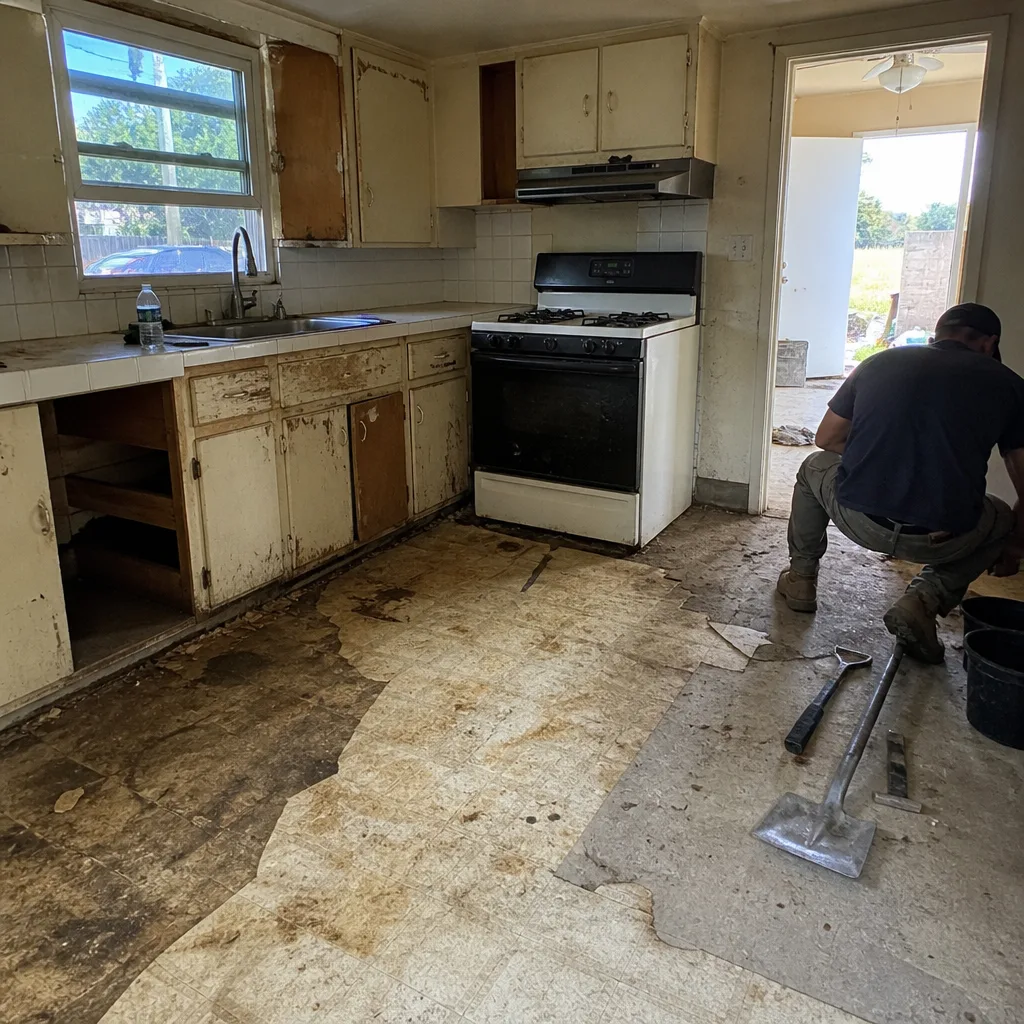 Before
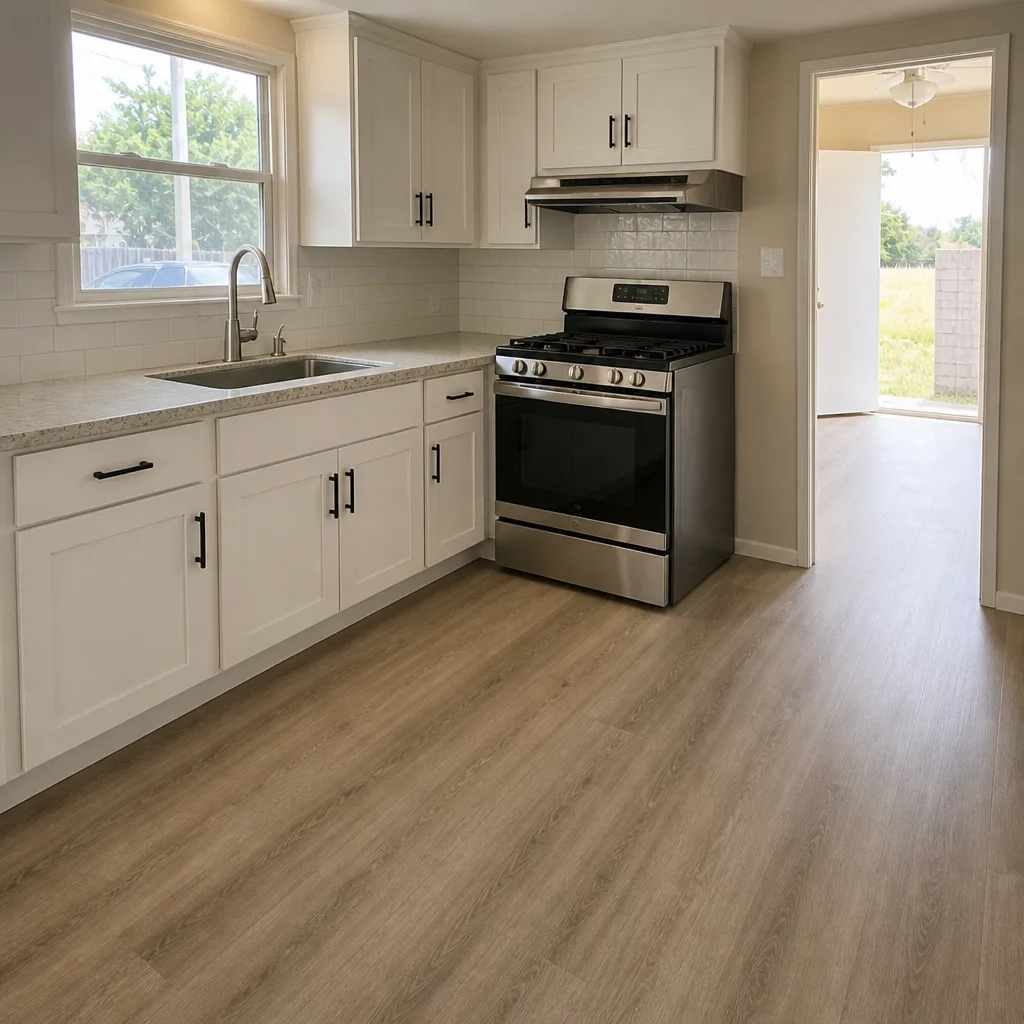 After
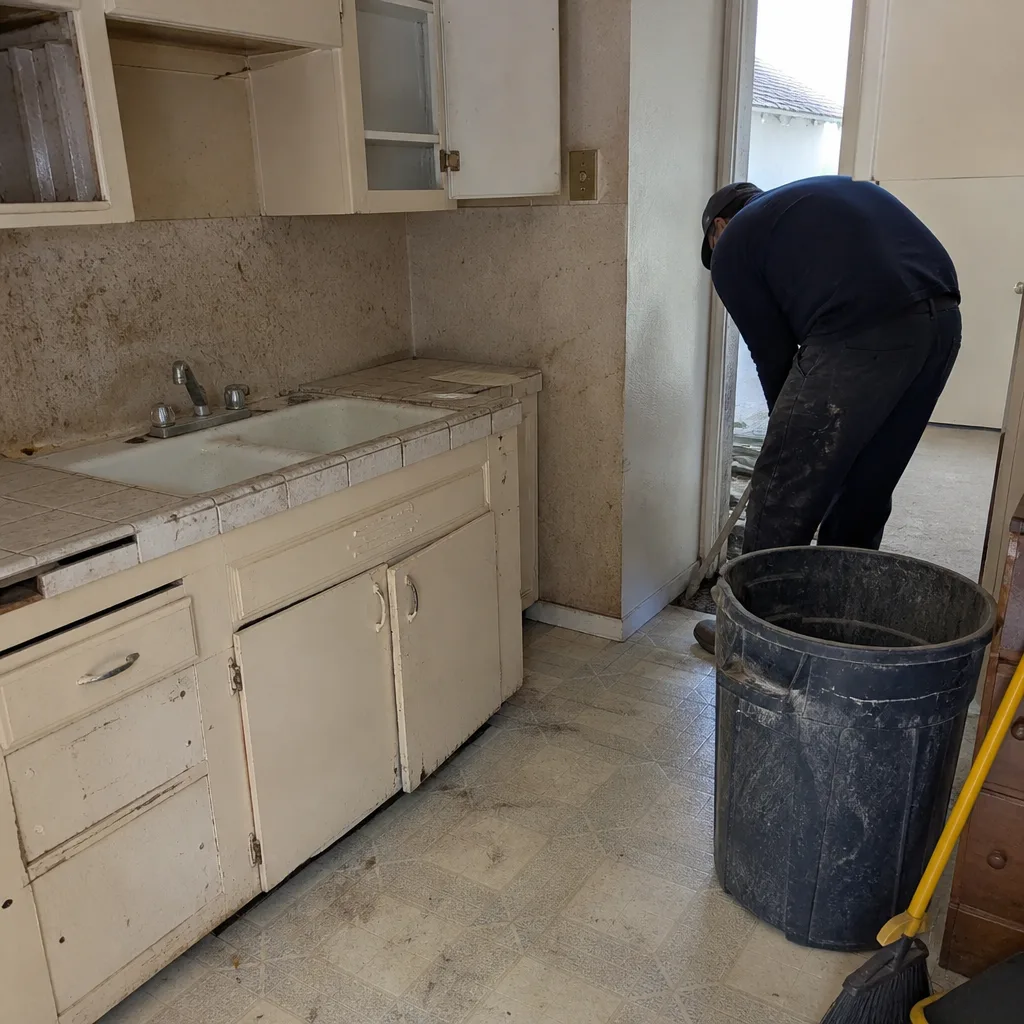 Before
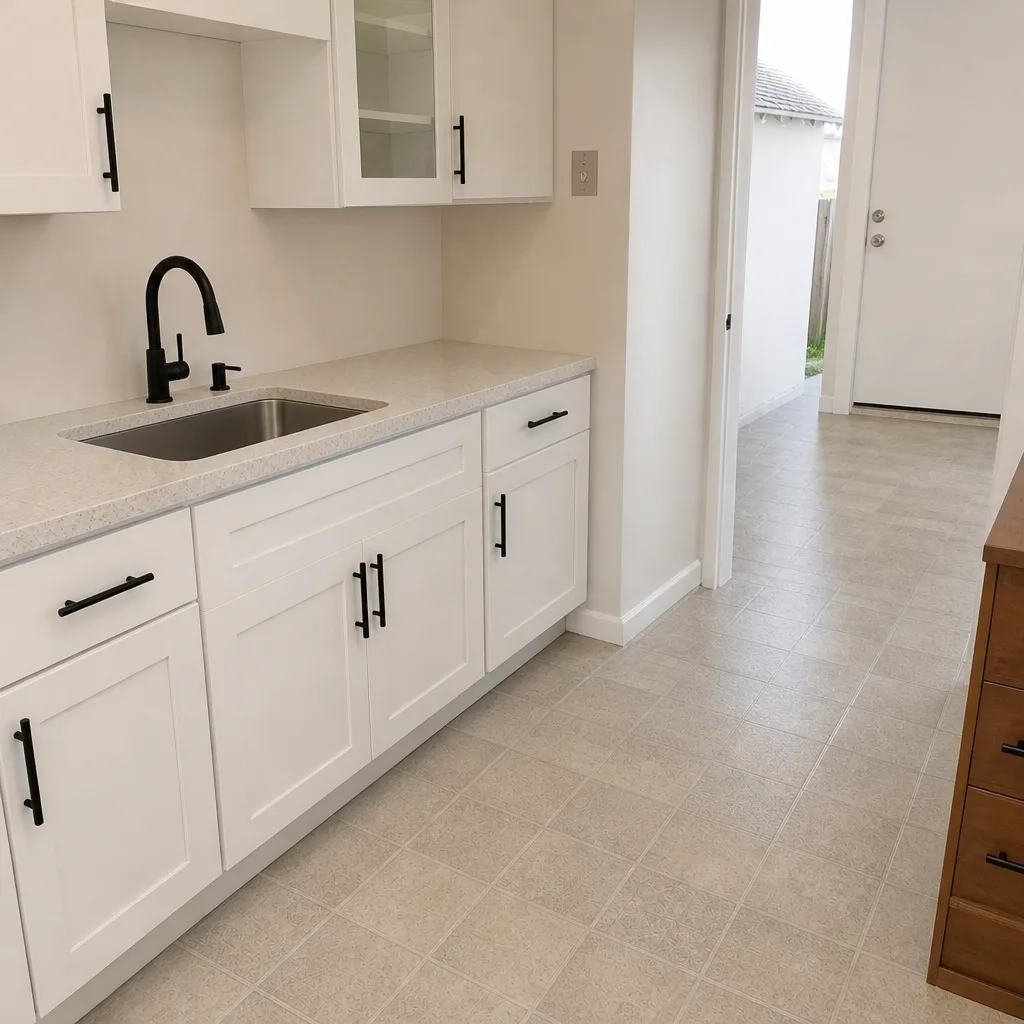 After
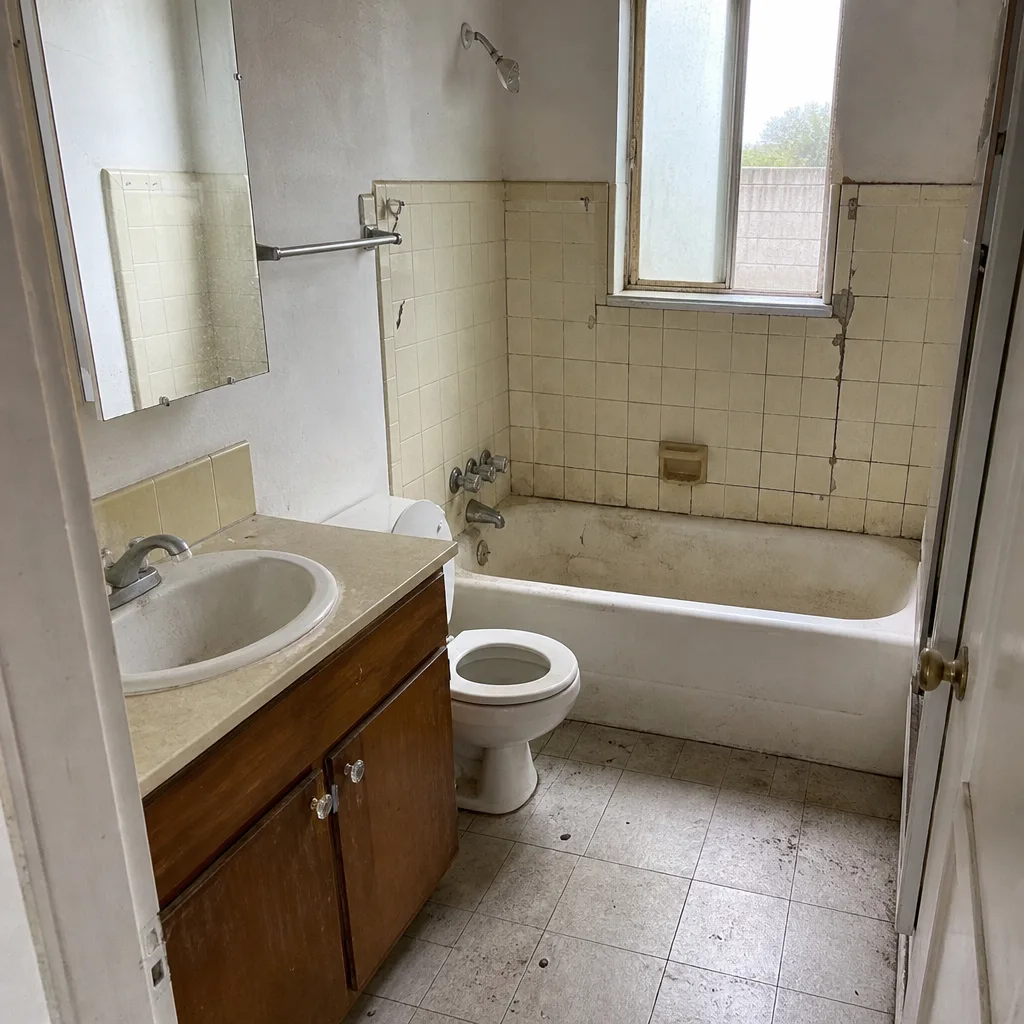 Before
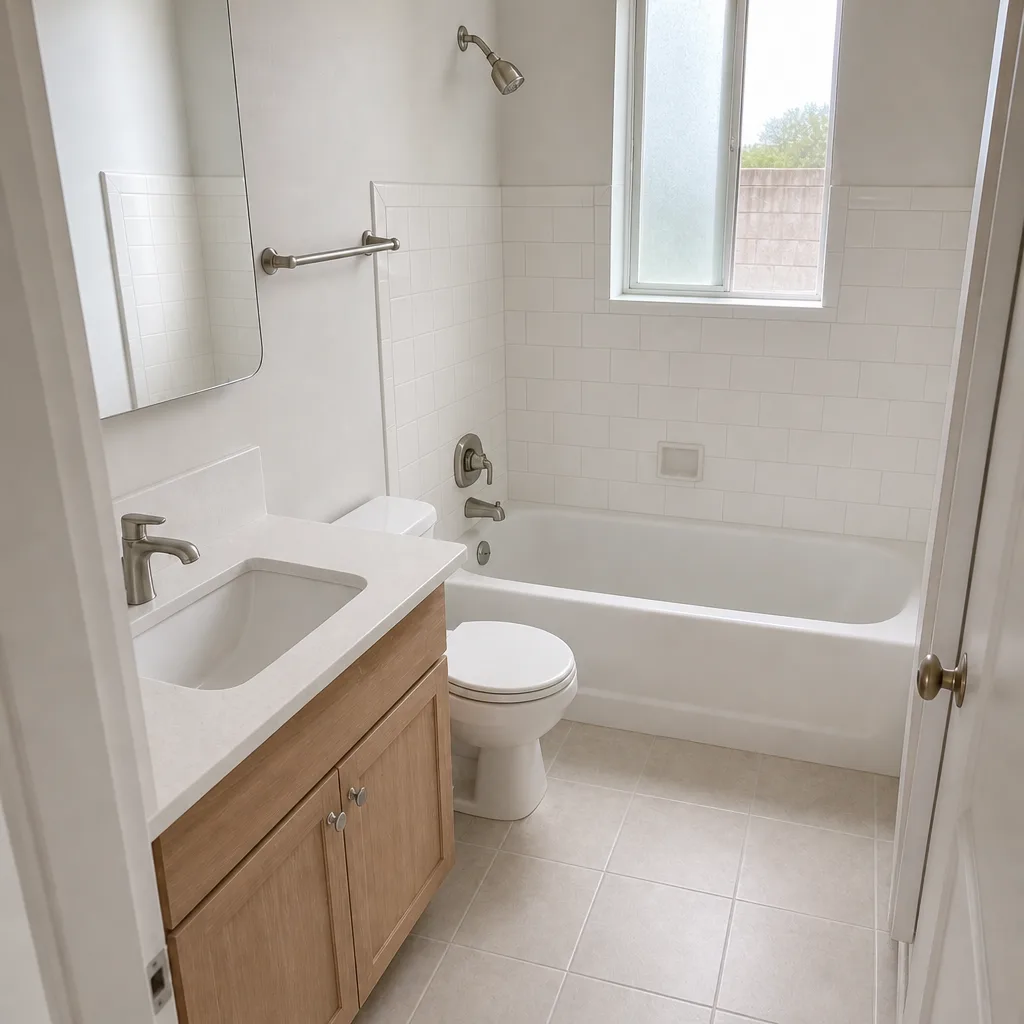 After
When to Call a Professional
Most of this guide is about what to look for before you hire. But there are moments to call a professional now: water is actively leaking around a shower pan or toilet seal, a permit inspector has flagged unpermitted work you inherited, or a previous contractor walked off and left a bathroom open to the studs. In those cases the sequence matters more than the fix – making the space safe, documenting what’s there, and getting a written scope and price before anyone touches the rough-in. We see these cases regularly across Los Angeles, and they almost always cost more when the first step is skipped.
Bradford Remodeling Co Los Angeles offers free estimates in Los Angeles – call (844) 343-6681. Live person answers, every time. A background-checked, uniformed technician will walk the space with you and put a written price in your hand before any work starts.
Frequently Asked Questions
A typical bathroom remodel in Los Angeles runs roughly $18,000 to $45,000 depending on scope, tile and fixture selection, and whether plumbing or electrical is moved. A cosmetic refresh (paint, fixtures in kind) sits at the low end; a full gut with slab work and new rough-in sits at the high end. We give you a written line-item price before any work starts, so the number doesn’t move at the door. Call (844) 343-6681 for an exact estimate – free and no obligation.
Look up the license on the California Contractors State License Board (CSLB) website. The status must read “Active,” with a current bond and no disciplinary flags. A suspended or expired license means the contractor is legally barred from working on your job. It takes about three minutes and it’s the fastest way to disqualify a bad contractor.
It depends on scope. Moving plumbing, electrical, or structural elements in a Los Angeles bathroom normally requires a permit and an inspection. A purely cosmetic refresh may not. The test is whether the work changes the systems behind the wall – if it does, the permit is required, and a by-the-book contractor pulls it in their own name before work starts. If a contractor tells you to skip it, ask why in writing.
Every completed Bradford Remodeling Co Los Angeles project carries a full-year written guarantee. If any part of the work we completed fails or isn’t done right inside that window, we come back and correct it at no charge. The terms are in writing and handed over at job close – a clean site, a documented scope, and a signed guarantee in your hand. Ask to see the guarantee language at the bid stage; any contractor should be able to show you one.
Only with a written change order you sign. A legitimate change order covers something genuinely hidden – rotted framing behind the tile, or galvanized plumbing that has to be replaced once it’s exposed. A price that moves without a signed change order is not a change, it’s a problem. Bradford Remodeling Co Los Angeles puts the price in writing before work starts, and any change is a written amendment you approve before the crew proceeds.
Stop all further payments, document the condition of the site with dated photos, and contact the CSLB to file a complaint. If the deposit was paid, the CSLB complaint process and your contract terms are the tools you have. Then get a written scope from a licensed contractor before anyone resumes work – the finish-out plan matters more than speed at this point. Call (844) 343-6681 and we’ll walk the site and put a written price together for finishing the job.
The Bottom Line
Bathroom remodeling fraud in Los Angeles is not random. It follows a script – the contract with no completion date, the deposit before a written price, the payment schedule instead of milestones, the materials left unspecified, the permits waved off, the subs swapped without notice. Every one of those warning signs is checkable before you sign. Check the CSLB license, refuse to pay before a written price, require the completion date in writing, and demand SKUs for the tile and fixtures. A contractor who can satisfy all four is one who can be held to the job. That’s the difference between a bad contract and a finished bathroom – and it’s the whole reason we do things the way we do.
Bradford Remodeling Co Los Angeles home | Kitchen Remodeling in Los Angeles
If you’re comparing bids for a bathroom in Los Angeles, call (844) 343-6681 for a free estimate. You’ll get a written price, a scope with named materials, and a live person on the phone – before anything starts.
Written by the team at Bradford Remodeling Co Los Angeles.