
Top Signs You Need Construction Service – Don’t Ignore These
A foundation crack wider than 1/4 inch isn’t a “maybe fix this someday” situation. In Los Angeles, it’s a material defect you’re legally required to disclose to buyers, and the repair cost grows roughly 40% for every year the soil movement continues unchecked. Most homeowners wait for a sign to become an emergency. The signs below don’t ask you to wait. Read them, measure against your own house, and if any of it sounds familiar, that’s your cue to get a written assessment before the calendar makes the decision for you.
If you’d rather have a professional look than crawl under the house with a flashlight, call (844) 343-6681 for a free estimate.
Key Takeaways
- Structural movement has measurable thresholds. Past 1/4 inch, it’s a construction problem, not cosmetic settling.
- Water intrusion you know about and don’t disclose can void an insurance claim and create seller liability in California.
- Electrical panels, missing GFCI protection, and non-code HVAC venting are permit-triggering conditions, not upgrade suggestions.
- A written assessment with a repair scope and a cost range is what you get before you commit to anything.
Structural Signals vs. Normal Settling: Where the Line Actually Is
Every house moves. Los Angeles sits on some of the most active geology in the country, and a certain amount of settling is a fact of life here. The question isn’t whether your house moves. It’s whether it’s moving in a way that crosses from normal into structural repair.
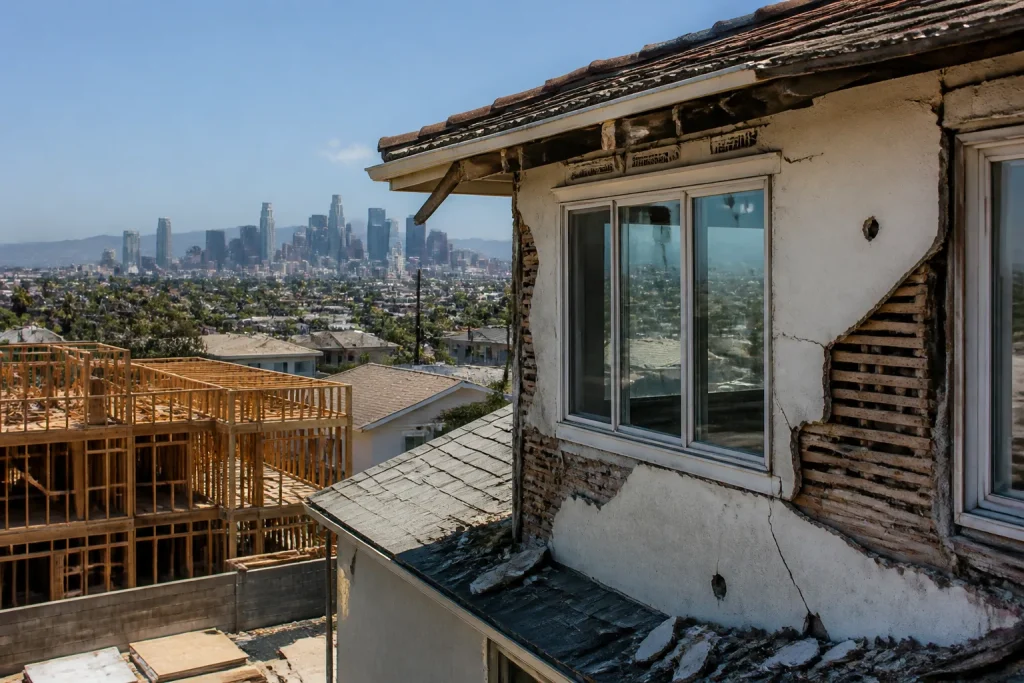
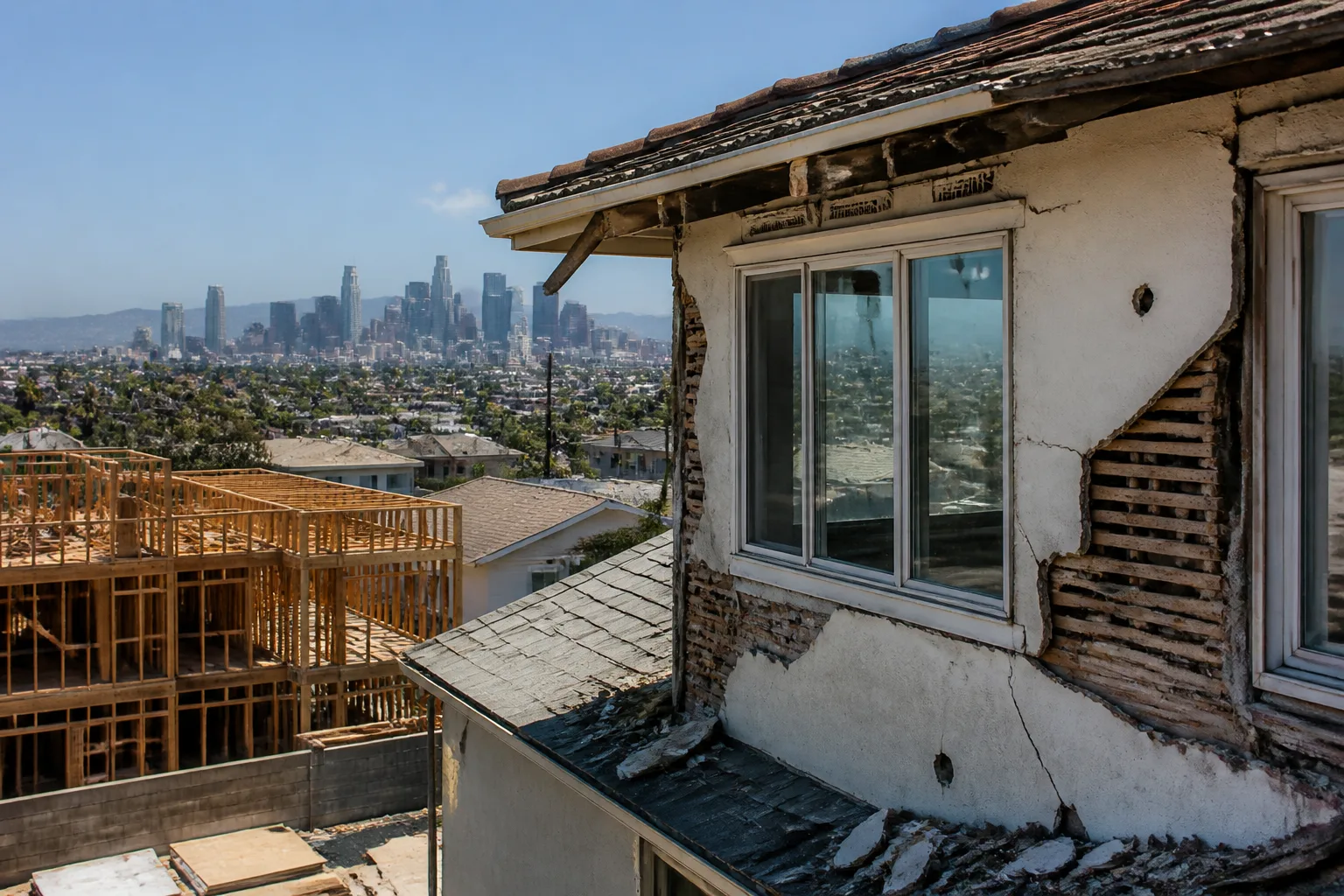
Here’s the line we use. A hairline crack in stucco or drywall under 1/8 inch, stable across a year, is cosmetic. A crack wider than 1/4 inch, or one that has grown since you last looked, is a different category entirely. So is a crack that’s wider at one end than the other, a door that sticks in summer and swings free in winter, or a floor that slopes more than a quarter inch over four feet.
Pattern matters as much as size. Vertical cracks in a foundation wall are usually shrinkage. Diagonal cracks that step along a masonry joint, or stair-step cracking in brick, usually mean differential movement – one part of the foundation is settling faster than another. In Los Angeles, that pattern often shows up on hillside properties and in older neighborhoods built on fill soil.
- Cracks wider than 1/4 inch, or any crack that has visibly widened since you last checked.
- Doors and windows that stick seasonally, especially if the sticking gets worse year over year.
- Floors out of level by more than 1/4 inch across a 4-foot span.
- Gaps at exterior trim or between the house and a attached garage that reappear after caulking.
- Chimneys or porches pulling away from the main structure.
We’ve pulled foundation assessments in Los Angeles where the homeowner had been caulking the same crack for four years. Caulk hides the symptom. It doesn’t stop the soil. When you’re ready to stop guessing, our General Contractor in Los Angeles team can put a scope and a number in writing.
Water Intrusion: What “Known Condition” Means for Your Insurance
Water is the most expensive thing that happens to a house quietly. It also carries a legal weight most homeowners don’t find out about until a claim gets denied. If you know about a leak, a recurring damp spot, or a stain that keeps coming back, that’s a “known condition” in insurance language. Insurers can deny a claim for damage that a reasonable homeowner should have addressed. And in California, that same known condition becomes a disclosure obligation when you sell.
The signs are usually not dramatic. A musty smell in a basement or crawlspace that never quite goes away. Efflorescence – the white powdery staining on concrete – which means water is moving through the masonry and evaporating on the surface. Bubbling paint on interior walls, soft spots in subfloor near a bathroom, or a water stain on a ceiling that “dried out.” It didn’t dry out. It’s still finding its way in.
Around Los Angeles, the pattern we see most is roof and flashing failure that shows up months after the rain stopped. Winter storms push water past compromised flashing at a chimney or a skylight, and by summer the homeowner is looking at a ceiling stain with no idea where it came from. A contractor-required assessment means tracing the water to its actual entry point, not painting over the evidence.
If you spot any of this, don’t wait for the next rainy season. Get it documented. A written report with photos and a repair scope is what protects you both with your insurer and at resale.
Electrical and Mechanical Signs That Trigger Permit Work

Some upgrades are optional. Some are code conditions you’re already in violation of, even if nothing has failed yet. Electrical and mechanical systems fall hard into that second category, and Los Angeles inspectors don’t negotiate on them.
Panel age. If your home still has a fuse box, or a panel from the 1970s or earlier, it predates modern capacity standards. Older panels can’t safely carry the load of a modern kitchen – induction range, dishwasher, microwave, and a few countertop circuits all at once. This isn’t about wanting more outlets. It’s about a panel rated for a house that no longer exists.
GFCI absence in wet areas. Ground-fault circuit interrupter protection is required in kitchens, bathrooms, laundry rooms, garages, and any outdoor receptacle. If you can plug a hair dryer into an unprotected outlet next to a bathroom sink, that’s a code gap. GFCI devices cut power when they sense a ground fault – the exact fault that causes shock near water.
Non-code HVAC venting. A furnace or water heater vented incorrectly can push combustion gases back into the living space. It’s silent, and it’s dangerous. If the venting was done by a previous owner without a permit, you own the correction.
- Fuse box or pre-1980 panel that’s never been evaluated.
- No GFCI protection at kitchen, bath, garage, or exterior outlets.
- HVAC equipment vented without a permit or inspected clearance.
- Any unpermitted electrical work found during a home inspection.
Electrical and gas work belongs in licensed hands. Panel swaps and gas appliance venting are genuinely dangerous, and we don’t recommend opening a panel or re-venting a furnace yourself. What a homeowner can do is get it assessed and get the permit pulled correctly. Our team at Bradford Remodeling Co Los Angeles handles that end, and the Bradford Remodeling Co Los Angeles home page lays out how we run a permitted job start to finish.
Related services in Los Angeles: Kitchen Remodeling in Los Angeles and Bathroom Remodeling in Los Angeles – both of which almost always surface an electrical or plumbing code condition once the walls open up.
The Disclosure Liability Timeline: When a Defect Becomes Your Problem
Here’s the part nobody explains until it’s expensive. In California, once you know about a material defect, the clock starts. When you list the property, you’re required to disclose it on the Transfer Disclosure Statement. “I didn’t think it was a big deal” is not a defense, and it’s not a repair strategy either.
A material defect is generally one that affects value, safety, or the buyer’s decision to purchase. That 1/4-inch foundation crack, an active roof leak, a non-code electrical panel – all of those qualify. Fail to disclose, and the buyer can come back after closing with a claim. That claim costs far more than the repair would have, and it comes with legal fees attached.
The timeline that matters is simple. From the moment you have actual knowledge of a condition, your exposure starts growing. Every year you let soil movement, water intrusion, or an electrical gap go unchecked adds to the repair cost and enlarges the disclosure you’ll eventually have to make. The homeowner who addresses it early spends the least. The homeowner who waits pays twice – once for the deferred repair, once for the small fortune it becomes.
A written assessment changes the equation. It documents what you knew, when, and what you did about it. That’s a much better position at resale than a caulk gun and a shrug.
How to Get a Written Assessment Before You Commit

An estimate is not an assessment. An estimate is a number. An assessment is a document that tells you what’s wrong, why, and how it gets corrected. Before you sign anything, ask for the second one in writing and check that it includes the following.
- Findings with specifics. Not “some foundation issues” but crack widths, locations, and floor-level measurements. Photos included.
- Root cause. A repair that treats the symptom without naming the cause is a callback waiting to happen.
- Scope of work. Exactly what gets replaced, repaired, or corrected, item by item.
- A cost range per line item, not a single blob number that moves at the door.
- Permit handling. Who pulls the permits, who covers inspection costs, and what happens if an inspector requires additional work.
- Materials specified by name and manufacturer, so the spec is traceable.
That last one matters more than people expect. When a scope names the actual product, like a Belgard paver or a GAF roofing system, there’s no ambiguity about what got installed and no room to substitute at the last minute. Brand names in a written scope are a quality control, not a sales pitch.
And when the work is done, “squared away” means a clean site, a documented scope, and a signed written guarantee in the homeowner’s hand – not a promise that lives in a phone call. That’s what The Garrison Standard requires on every job. Our technicians have up to 22 years of experience, and every project carries our 365-Day Done Right Promise: if the work fails inside that year, we come back and correct it at no charge.
The Bottom Line
The signs that need a construction professional aren’t always loud. A widening crack, a stain that keeps returning, a panel that predates the appliances plugged into it – each one is a condition that grows in cost and legal exposure the longer it sits. Get it measured, get it in writing, and get the scope before you commit a dollar.
If you’re in Los Angeles and need help, Bradford Remodeling Co Los Angeles offers free estimates – call (844) 343-6681. A live person answers the phone 24 hours a day, seven days a week, and you’ll have a written price before any work starts. That’s non-negotiable on every job we take.
Frequently Asked Questions
Measure it. A crack under 1/8 inch that hasn’t changed in a year is usually cosmetic settling. A crack wider than 1/4 inch, one that’s widening, or a stair-step pattern in masonry crosses into contractor-required repair. In Los Angeles, hillside and fill-soil properties are more prone to differential movement, so pattern matters as much as size. Call (844) 343-6681 for a written assessment – estimates are free.
It can. Once you have knowledge of a leak or recurring damp condition, it’s a “known condition” that insurers may use to deny a claim for resulting damage. In California, that same knowledge also becomes a disclosure obligation when you sell. Documenting the condition and addressing it protects you on both fronts. Call (844) 343-6681 to get a repair scope in writing.
Not on a Bradford job. You get a written price before any work begins, line by line, and that’s the price. If an inspector requires additional work during a permitted job, we document it and confirm with you in writing before the scope changes. No surprise invoices at the door. Call (844) 343-6681 for an exact quote – estimates are free.
Yes. Electrical panel replacements, GFCI corrections, HVAC re-venting, and structural repairs all require permits in Los Angeles, and we handle the pulls and the inspections. Unpermitted work from a previous owner becomes your correction to own, so it’s worth resolving before a sale. Call (844) 343-6681 to talk through what your project needs.
Written by the team at Bradford Remodeling Co Los Angeles.
Need Construction Help?
Call Bradford Remodeling Co Los Angeles - licensed & insured, here with fast after-hours help in Los Angeles.
(844) 343-6681