

Emergency General Contractor Near Me: What Los Angeles Homeowners Should Do First
In a Los Angeles construction emergency, the order you do three things decides whether your insurance claim survives: document the damage first, mitigate the damage second, sign a contract third. Most homeowners reverse that order and call a contractor before they’ve photographed anything. That single mistake is how a covered loss turns into a denied repair claim. This guide is a decision sequence, not a phone number. If you’d rather not sort through it alone, call (844) 343-6681 and a live person will pick up.
Why the First Contractor You Find Is Usually the Wrong One
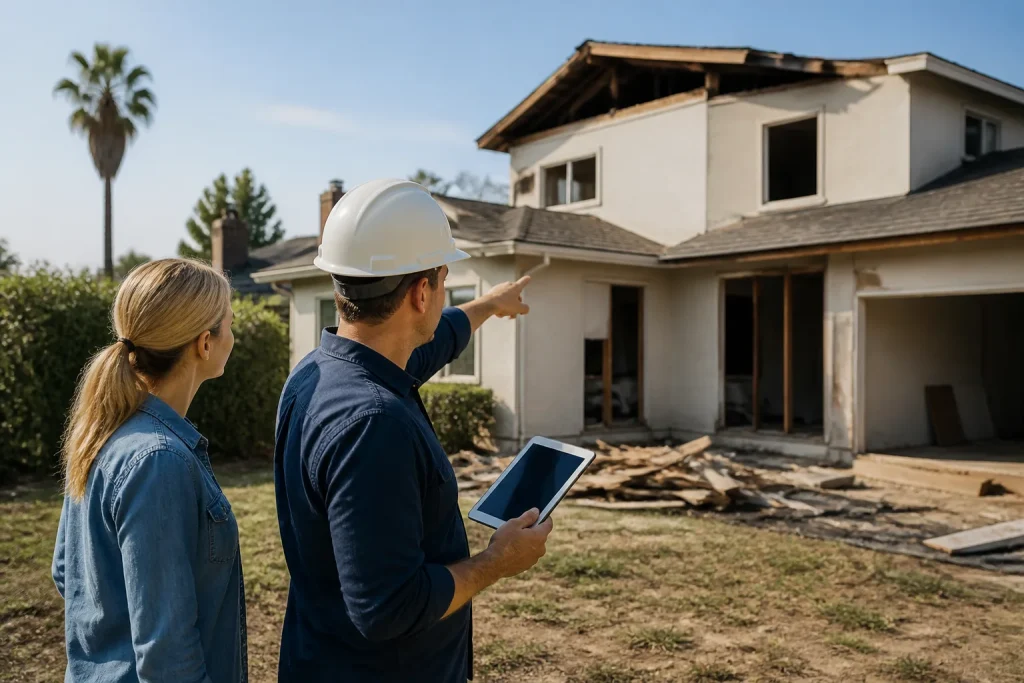
After a water main break floods a crawlspace or a eave collapses over a garage in the Valley, the instinct is to grab the first “emergency contractor” who answers. Here’s the problem the California Contractors State License Board (CSLB) has documented for years: unlicensed operators sweep into Los Angeles after storms, structural failures, and fires, and they know the window of panic. They take a deposit, pull no permit, and disappear before inspection.
The damage they leave goes beyond shoddy work. If the repair itself was done without a required permit and your insurer inspects – and after a large loss they usually do – the claim for that repair can be reduced or denied, because an unpermitted structure is not a code-compliant structure. You pay twice: once for the bad repair, once to undo it.
What a licensed Los Angeles general contractor gives you is traceability. The license pulls up on the CSLB database in thirty seconds. The permit pulls up on the LADBS system. The written price is on paper before a tool comes out. In an emergency, that paper trail is the whole game.
The Two-Hour Decision Sequence: Document, Mitigate, Contract
Run these steps in this exact order, every time. The sequence matters more than the speed.
- Document (0 – 30 minutes). Photos and video of every affected surface, from wide shots to close-ups. Pan slowly. Narrate what you’re filming. Note the time. Do not move or discard damaged material yet – your adjuster needs to see it in place.
- Snapshot the cause (30 – 45 minutes). Photograph the failed component – the burst pipe, the cracked joist, the broken flashing – before anything is disturbed.
- Mitigate (45 – 90 minutes). Stop the water, shut the gas if you smell it, board the opening, tarp the roof edge. Mitigation is temporary and it is what insurers expect you to do to prevent further loss. It is not the repair.
- Call your insurer’s claims line (90 – 120 minutes). Open the claim, get a claim number, and ask what documentation the adjuster will want for the specific loss type. Write down their name and the time.
- Contract (only after the first four are done). Now you hire – with a written scope and a written price.
One detail most guides skip: photograph the water line on drywall before you cut it. We pulled a job over in Sherman Oaks where a homeowner had already cut out the saturated drywall, and the adjuster had no height reference for the flood cut. The number got negotiated downward because the documentation was gone. Fifteen seconds of camera work would have protected it.
What LADBS “Emergency Work” Exemptions Actually Cover
Los Angeles building code has narrow emergency provisions that let certain protective work happen before a permit is issued – typically securing a structure, shoring, and stopping active damage. Those exemptions do not cover rebuilding. They do not cover finish work. They do not cover replacing a wall, a floor system, or a roof. Once the emergency is stabilized, the actual repair requires a permit from the Los Angeles Department of Building and Safety like any other job.
What the exemption does not provide, in plain terms:
- Any authority to skip plan review for structural repair.
- Any authority to skip inspection on electrical, plumbing, or mechanical rough-in, even if it was damaged by an emergency event.
- Any protection for the homeowner if the “emergency” work is later judged to be a repair that needed a permit up front.
A licensed contractor will tell you which of your items are emergency-stabilization work and which need a permit pulled and inspected. That distinction should appear on your written scope before any demolition begins, not after.
The Insurance Adjuster Protocol: What to Have Ready Before Anyone Touches the Structure
Adjusters are not the enemy. They’re working a checklist. The homeowner who hands them a complete file on day one gets a smoother claim than the one who produces it in pieces over three weeks. Before any contractor touches the structure in a Los Angeles emergency, have this documented:
- Time-stamped wide and close photographs of every damaged area, plus video.
- A written log of the event – what failed, when you noticed, when you shut off water or gas.
- Receipts or photos of any personal property damaged inside the affected area.
- Your claim number and the adjuster’s direct contact.
- A written temporary-mitigation record: what was done, by whom, and when.
If your loss is large, ask the insurer in writing whether they want an independent adjuster or a structural engineer assigned before repair begins. That step prevents the ten-day argument where the contractor’s scope and the insurer’s scope don’t line up. We’ve watched that argument cost homeowners three weeks of displacement over a dispute that could have been resolved up front with one email.
How to Vet an Emergency Contractor in Under 10 Minutes
Four moves, in this order. Do them on your phone while you’re still standing in the damaged room.
- CSLB mobile lookup. Pull up the CSLB website on your phone, search the license number the contractor gives you, and confirm three things: the license is active, the classification matches the work (a “B” general building license for structural repair), and there is no disciplinary action on file.
- Four-question verbal screen. Ask, in plain words: (1) “What is your CSLB license number?” (2) “Will you pull the permit under your license, and can I see the LADBS permit number?” (3) “Will the price be in writing before any work starts?” (4) “What does your written guarantee cover, and for how long?” A pro answers all four without flinching. A storm-chaser changes the subject on number two.
- Certificates of insurance. Ask for the certificate of insurance for general liability and workers’ compensation, and confirm the policy is current. If someone is injured on your property and there is no workers’ compensation coverage, the exposure can land on your homeowner policy.
- Written scope before written price. Any contractor who gives you a price with no scope attached is guessing. The scope comes first. The price follows.
For the longer view on how we approach this in Los Angeles, see our General Contractor in Los Angeles page – it walks through what a properly documented job looks like from first walk-through to close.
What an Emergency Scope of Work Document Must Include
You will live with this document if a dispute arises six months after the repair. Get it right the first time. A defensible emergency scope includes:
- The line-item breakdown – materials, labor, permit fees, and any temporary mitigation, priced separately rather than lumped.
- The permitting statement – which items require a LADBS permit and who pulls it.
- The exact material specifications – brand and product for anything visible or warranty-bearing, so there is no substitution argument later.
- The change-order rule – in writing, stating that no additional work happens without a signed change order and a new written price.
- The guarantee terms – what is covered, for how long, and what “made right” means in practice.
- The close-out deliverable – clean site, signed guarantee in the homeowner’s hand, and a copy of every inspection record.
At Bradford Remodeling, that paperwork is called The Garrison Standard, and it means every price is written before any work starts – no numbers that move at the door – and every completed project carries the 365-Day Done Right Promise: if the work fails inside that window, we come back and correct it at no charge. Our technicians have up to 22 years of experience, they are background-checked and uniformed, and someone answers the phone 24/7. For kitchen and bath work specifically, our Kitchen Remodeling in Los Angeles and Bathroom Remodeling in Los Angeles pages cover the same documentation standard in detail.
When to call a pro: if a structural member is involved, if the loss is over a few thousand dollars, if any permit will be required, or if you’re unsure – call. Emergency mitigation of a water or structural loss is not a homeowner job, and a wrong call on shoring can turn a repair into a rebuild. For modern modular and prefab homes – Cover, Dvele, Mighty Buildings, Boxabl – the emergency protocol is the same, but the manufacturer’s specifications and panel-specific repair guidance matter more, and the contractor must know the system before touching it.
The Bottom Line
Document first. Mitigate second. Contract third. That’s the sequence that protects you in Los Angeles. Vet the contractor on the CSLB database in under ten minutes. Get the permit pulled and inspected. Get the scope in writing before the price. And read the guarantee terms before you sign, not after.
If you’re in Los Angeles and need help, Bradford Remodeling Co Los Angeles offers free estimates – call (844) 343-6681. A live person answers, 24/7, and you’ll have a written price before any work starts. For a full picture of the company, start at our Bradford Remodeling Co Los Angeles home page.
Frequently Asked Questions
Yes, for the repair itself. LADBS allows narrow emergency-stabilization work before a permit is issued – securing a structure, shoring, stopping active damage – but the actual repair requires a permit. If someone tells you the entire job can skip the permit, ask for that in writing, then call (844) 343-6681 and get a second opinion first.
It can be. If the repair was done without a required permit and the insurer’s inspection finds that, the claim for the repair itself can be reduced or denied. The policy usually requires code-compliant work. Verify the CSLB license before anyone starts – and call (844) 343-6681 if you want to confirm what a licensed scope should look like.
For genuine emergencies – active water intrusion, roof breach, structural instability – a licensed Los Angeles contractor should be able to reach you the same day to stabilize the property. Non-emergency repairs are scheduled normally. What matters more than raw speed is that the contractor answers the phone with a live person, confirms their license number, and states in writing what the stabilization will cost before starting.
Line-item pricing, the permit statement, the material specifications by brand and product, the change-order rule in writing, the guarantee terms with a specific length, and the close-out deliverable. If any of those six items is missing, the scope is not defensible. Call (844) 343-6681 for a written scope and a written price – estimates are free.
Written by the team at Bradford Remodeling Co Los Angeles.
Need Construction Help?
Call Bradford Remodeling Co Los Angeles - licensed & insured, here with fast after-hours help in Los Angeles.
(844) 343-6681